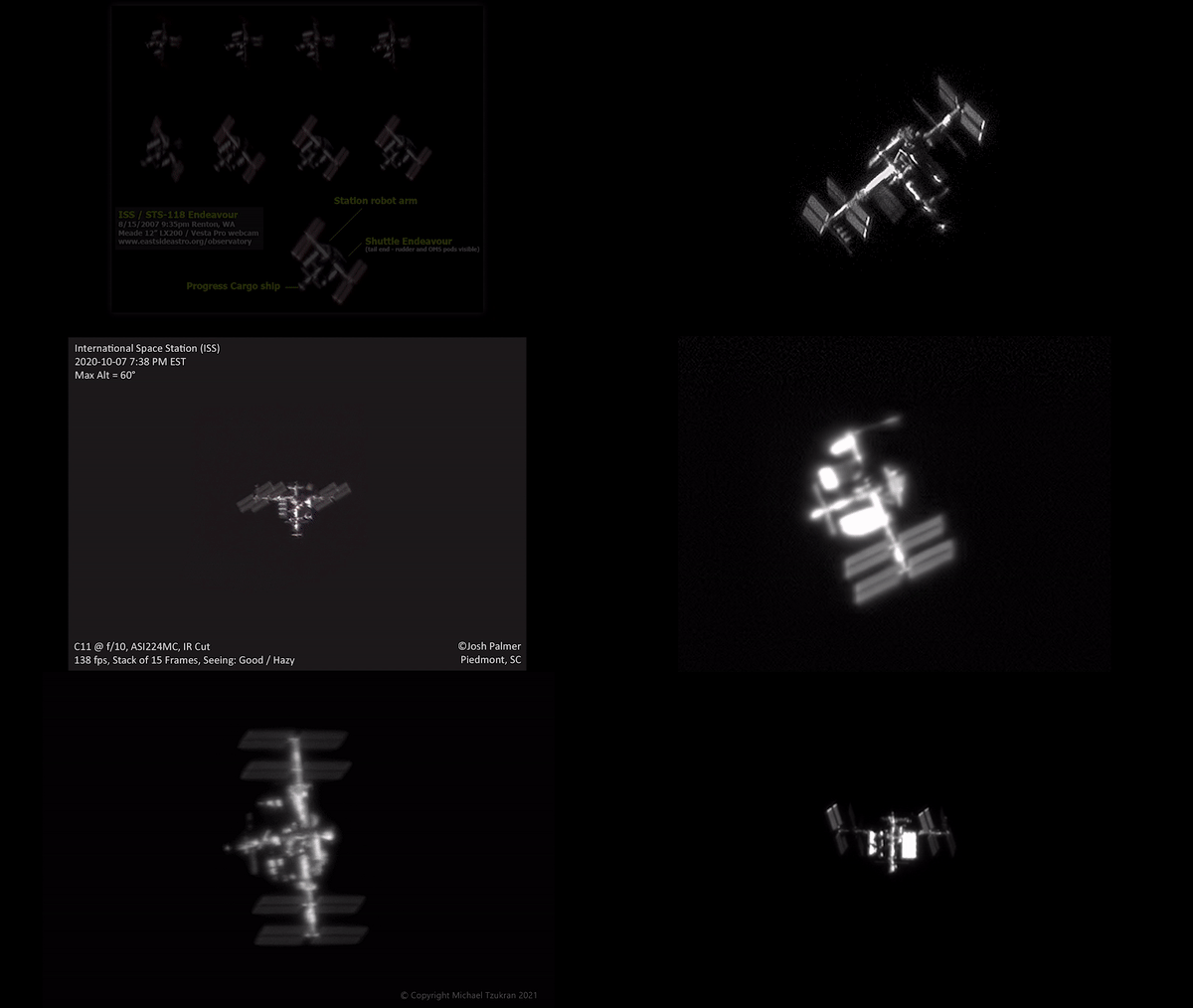
I would encourage everyone who has been involved in this specific type of astrophotography to send your best shots. Your photo must me close-up taken at high magnification, also solar/lunar transits are welcome too! If I had to define minimum requirements, it should be certain level of details that show the structure of the station.
If smaller elements also visible (like Bigelow Expandable Activity Module (BEAM), Cupola, Leonardo module, Quest airlock etc. or berthed spacecrafts like the russian Progress and Soyuz (Roscosmos), Dragon (SpaceX), Cygnus (Northrop Grumman – former Orbital ATK ), japanese HTV (Japanese Aerospace Exploration Agency or JAXA) – that’s even better!
Also I will extend the type of photographs I accept here to wide angle composite photos, as long as they show an ISS or cargo spacecraft flyby with very scenic background….
Also your post should contain UT time, date, equipment, flyby details and write in brief about how you took the shot.
Please send your photos to metrolinaszabi@gmail.com email address. The photos are arranged by alphabetic order of the imagers.
(Can’t guarantee though that all the photos I’ll receive will be uploaded)
So far these amazing photographers shared their amazing photos with us:
Andreas Hauf, Antonio Vilchez, Christian Fröschlin, Cirrusmoon, Christopher Becke, Denis Huber, Ethan Roberts, Grant Petersen, Ian Griffin, István Csabai, Martin Lewis, Monika Landy-Gyebnár, Péter Agárdi, Philip Smith, Ralf Vandebergh, Roger Hutchinson, Sage Grey, Tom Jones, Zsolt Fejes
Andreas Hauf
(Andreas’s Instagram profile – automated tracking with capable mount )
At the time of transit, Jupiter was at 29º elevation and the ISS crossed 810km away. Imaging telescope or lens:Takahashi FOA-60 Imaging camera:ZWO ASI183MM Mount:Celestron Evolution Software:Photoshop CS6, PIPP Filter:Baader Planetarium G Accessory:TeleVue barlow x2 (at 1,4x). 7% of real speed.
All pictures were captured with the Celestron 8″ CPC 800 XLT. All pictures were taken with industrial / planetary type cameras from FLIR (formerly Point Grey). Old ones are Flea3 1.3 MP RGB from 2015 onwards mostly Blackfly 2.3 MP RGB (frequently with barlow as it has large pixels) or BlackFly S 5 MP mono (typically without barlow). The newer cameras have CMOS sensors with the interesting property that frame rate depends only on height of ROI so I typically shoot narrow strips like 2448 x 680 @ 180 fps so a good hit can give a lot of images for stacking from a single sensor pass if lucky. Some of the images were shot in 12 bit mode to better cover the dynamic range between panels and bright modules but most in 8 bit as it gives higher frame rates.
Stacked view of ISS from today’s solar transit data. 22 x 0.55 ms Ha 35 nm + OD 3.8 solar foil in Celestron 8″ + 0.63x reducer
International Space Station Sun altitude 58° and reasonably clear skies although it ended up being a tight race against clouds. 11 frames covering 0.15 s real time, each 0.55 ms Ha 35 nm + OD 3.8 solar foil in Celestron 8″ + 0.63x reducer
Animated view of ISS solar transit at actual speed
Above: a lunar transit captured in Williamsburg, VA on 3/25/2018 at 7:04 pm EDT (12:04 am GMT 3/26). Captured with a Canon T5i through a Celestron 8″ SCT on AVX mount.
Above: Lunar transit on 11/27/2017 from Hampton, VA, 5:41 pm EDT, (9:41pm GMT), Captured with a Canon T5i through a Celestron 8″ SCT on AVX mount.
Above: Solar transit on 7/9/18 8:52 am (1:52 pm GMT) Captured with a Canon T5i through a Celestron 8″ SCT on AVX mount.with Celestron solar filter.
Unfortunately this is the best I can get close-up! July 09 2017, Captured with a Canon T5i through a Celestron 8″ SCT on AVX mount, manual guiding.
This morning’s ISS pass with Dragon. I had gotten an alert (as I usually do) of this morning’s ISS pass (5:51-5:56 am). The maximum altitude was only 20°, so I wouldn’t have normally attempted a capture, but knowing that Dragon was to be released about 45 minutes earlier, I decided to give it a try. Canon T5i with 18-200mm lens, set at 18mm. Quick focus, then 30s exposures, f/4, ISO800 07.01.2020
Location: Johannesburg, South Africa Date 2018/11/11 Equipment: Samsung Galaxy S8 smartphone, Solomark smartphone adapter, 7mm Celestron LX Xcel eyepiece and 2 x Barlow mounted on a Sky-watcher dobsonian telescope 203mm/1200mm Single frame grabbed from Video. Settings ISO 800, Exp 1/2000 sec
Location: Johannesburg, South Africa Date 2018/09/12 Equipment: Samsung Galaxy S8 smartphone, Solomark smartphone adapter, 7mm Celestron LX Xcel eyepiece and 2 x Barlow mounted on a Sky-watcher dobsonian telescope 203mm/1200mm Stacked image from Video: Settings ISO 800, Exp 1/2000 sec Run through PIPP and stacked best 3 frames with registax.
Taken on 14th August 2019, using a 150mm refractor. Sony A9 camera was used in high speed mode (20fps compressed raw images) 1/4000 sec exposure at ISO 1600. New Zealand
Istvan Csabai
Location: Zagyvarékas, Hungary Time/date: 22:20 21/05/2018 Equipment: 180/2700MC + ASI385MC Exp.:0.6 . Gain: 350 Maximum elevation of the ISS was 74° at visual magnitude of – 4.0, distance about 422km from my location.
20/10/07 Montage of ISS in early days showing different perspectives for a 45deg alt pass
10/2/08 ISS with Atlantis docked and end-on perspective – 222mm dobsonian at f12 with DMK21AF04.AS
29/7/08 Detailed view of ISS with single set of solar panels on each truss
23/3/09 ISS with Discovery attached and showing engine nozzle
20/5/09 One of my favourite views to date – 222mm dobsonian at f12 with DMK21AF04.AS
2/3/11 ISS (2 versions, one annotated) with Discovery attached (cargo doors open) and Steve Bowen in EVA at end of Columbus laboratory (see in depth analysis of this image at http://www.skyinspector.co.uk/sts-133-spacewalk )
23/8/11 ISS rising over Penzance
28/3/18 ISS pass using a 222mm dobsonian and an ASI174MM showing decent amount of detail
Martin Lewis’ amazing photo of the event taken with his hand-guided home-built 222mm Dobsonian with ASI174MM camera, 2.7x Barlow, and a red filter from his back garden in StAlbans, UK.
Martin Lewis’ amazing animation of the event taken with his hand-guided home-built 222mm Dobsonian with ASI174MM camera, 2.7x Barlow, and a red filter from his back garden in StAlbans, UK.
ISS Location: Hungary Time/date: 24.09.2018 ISS composite shot, Nikon D5300 + kit lens
Today I could finish a big project celebrating the 20th birthday of International Space Station. ISS was “born” on 20th November 1998, when its first part, the Russian Zarya modul was launched from Bajkonur. The 20th birthday of ISS was on 20th November this year and I decided to celebrate it with 20 different flyby photoes each taken during this November. It was a hard work, not because I had no patience to make it all happen, but because of our notoriously bad weather. The first 2 weeks of November were extremely lucky, and I could capture at least one flyby each dawn, then after some break ISS came back to our evening sky on 24th November – and then the weather was awful for several days. I almost gave up all hope but then two more proper evening came, so I could finish the project today evening at 18:12 local time when ISS disappeared in the shadow of our planet after its 2nd flyby this evening. I hope I could collect a varied bunch of pics with somewhat varied scenery (I had to travel for clear sky sometimes)!
Péter Agárdi
Péter sent me these amazing shot of ISS (first one is my favourite). These are his words:
It was more than ten years ago I got into astrophotography, but with many of my hobbies, they come and go from time to time. I still have the same telescope I bought in around 2004 which is a Skywatcher 114/900 on an EQ2 mount.
First off one of my more advanced setup I got a very old digital camera a Casio QV3500 for the repurpose to astrophotography meaning removing all the lenses to get it into direct focus. I chose this model because I knew it has full manual modes to shoot with (not just the auto crap that was used around that time) AND the thread to put teleconverters or such. This comes into play later.
After some practice on airplanes the day of ISS photography finally came. Here is my first result
After a couple of years
Then some more years passed, I got a Canon 600D which is the best stuff I’ve every used so far! The articulated screen makes life so much easier! Taking photos of ISS with this setup resulted this picture
Later I got into recording videos because it seems a better idea making more frames which can be used. I wrote a little python program to analyze the frames and get only the ISS cropped. Here is a new picture, numbers are now relate to the frame number of the shot video
Yet another couple of month later (there were some thin clouds this day)
This is my last useful attempt so far.
With this setup (Skywatcher 114/900 + Canon 600D) I use the following parameters:
Shooting FullHD cropped (using only the FullHD sized area of the sensor) video with ISO 800 and around 1/1000 shutter speed. White balance set to Sunlight. No filters or barlow used.
Péter Szalai
(Peter managed to take his first real good International Space Station lunar transit a few days ago – his description of the event)
All circumstances were perfect for a good ISS lunar transit, I didn’t even had to travel at all and ISS were only 465km away from my location. I got my transit predictions from Calsky, charged the batteries on the night before and I was ready for the challenge. The sky was clearing nicely after sunset despite the cloudy forecast, so I hoped this might be my night. I used a Skywatcher 150/750 newtonian telescope on EQ3 mount and a Canon 1200D in prime focus.I took a few test shot on the 99% illuminated Moon, expo time at 1/1250 and ISO 400. I was considering video over single shot, eventually choose the latter. Then hesitating between shooting in raw format, but due data jamming I didn’t want to risk missing it so I went for jpeg format.I started taking photos in continuous mode 2-3 seconds before the predicted transit and when I found two of my shots had ISS on it I was very happy.
10.01.2020 – Hungary
Philip Smith
(Philip’s Facebook profile, Youtube channel – automated tracking with capable mount )
I imaged the ISS and Cygnus spacecraft at max pass 53 deg. on 10-02-13 Time 5:25am EST I used my Meade 10SC OTAwith a 2X barlow with an Orange Filter on a Skynyx 2.0 M chip size 640×480 on CCD @ 66 FPS With Emmanuel Rietsch Tracking System Manorville, NY USA
I saw the ISS was going to make a pass of 89° over my observatory at 3:42 AM EST. So I made plans to record it. I used an EQ-G Mod mount by Emmanuel Rietsch and his Tracking System with my 11 Edge HD / SKYnyx 2-0M CCD Camera at 66 fps on a 2x barlow and orange filter. Manorville, NY USA
I saw the ATV-5 was docked to the ISS and was going to make a pass of 82° over my observatory on 08-22-2014 at 8:18pm EST. So I made plans to record it. I used my EQ-G Mod mount by Emmanuel Rietsch and his Tracking System with my 11 Edge HD / SKYnyx 2-0M CCD Camera at 66 fps with a 2x barlow and orange filter. Manorville, NY, USA
The weather was -3° and snow on the ground. I felt like I was inside a bid refrigerator. The sky looked clear but the seeing was poor. I imaged at 65 fps. This image is 4 images stacked in RegiStax 5 and CS6 processing. The image also has more info on it. I used an EDGE HD 14 with 1.6 barlow and orange filter. Camera was SKYnyx 2.0 m. Mod EQ-G mount with ER Tracking System and mod part that I also added. Manorville, NY, USA
This is my ISS image that I recorded and stacked about 76 images to make this high resolution image from my backyard on 8-03-15. As I was on the internet I saw a docking diagram overlay image taken from Soyuz TMA-17M before successfully docking to ISS. That image was from a You Tube NASA video I took a screenshot of to show you and compare it with my ISS high resolution image from my backyard. The ISS max pass that day was 77°. Manorville, NY, USA
I recorded on 8-17-15 Tiangong 1 with the 2 solar panels in view at 78° ….AND… ISS at 59° from my backyard. So I made this combo image to show you my images in true relation to each other. I used Edge HD 14 OTA with a SKYnyx 2.2 Mono CCD camera that has global shutter. The Barlow X 1.6 with an Astrodon orang filter. All on an custom modified EQ-G and ER tracking software made for me and my mount. Manorville, NY, USA
I imaged on 8-19-15 the ISS at 59° from my backyard. I used my Edge HD 14 OTA with a SKYnyx 2.2 Mono CCD camera that has global shutter. I also used a 2X Barlow with an Astrodon orange filter. All on an custom modified EQ-G and ER tracking software made for me and my mount. Manorville, NY, USA
This ISS was not in full Sun light at time of recording on 11-19-2016. I processed in VirtualDub and RegiStax5 to bring out more detalles in the ISS. The telescope was an Hedge HD 14 with a 1.6X barlow. Imaging camera was ZWO ASI174 mono with an orange filter at full frame then cropped video. All on a modified tracking EQ-G mount. Manorville, NY, USA
I think I am the 1st Amateur Astronomer from his own backyard to image BEAM Module Habitat docked to The International Space Station, Before and After BEAM was FULLY Pressure Inflated. (BEAM) is The Bigelow Expandable Activity Module is seen fully inflated on the International Space Station on my image dated May 28, 2016 after being successfully expanded to its full size on May 28, 2016. The Bigelow Aerospace-built BEAM is a prototype space habitat for future space stations, moon colonies and moon bases. So now I think I am now part of that history. Manorville, NY, USA
I imaged the ISS on 8-09-17 from my backyard. Max pass was 58° at 9:42pm EST. The telescope was an Hedge HD 14 with a 2X barlow. Imaging camera was ZWO ASI174 mono with an orange filter. The mount and software helped me lock onto the ISS…………Seeing was good. Manorville,NY USA
I imaged the ISS on 3-25-18 from my Manorville NY, USA backyard. Max ISS pass was 62° at 8:06pm EST. The telescope was an Hedge HD 14 with a 1.6X barlow and red Astrodon filter on my ZWO ASI290 mono camera. The mount and software helped me lock onto the ISS…………The seeing at the time was poor. I did not stack any of these images. Manorville,NY, USA
I imaged the ISS on 5-18-19 from my backyard, Manorville NY, USA. ISS Max pass was 73° at 9:31 pm EST. Please Note: This ISS short video is at max 73° pass time and not in full Sun light at that time because of Earth’s curve and point of view to the ISS. The Sun was at -14.2°. You will see some solar flares from the Sun light reflecting off the ISS. The telescope I imaged with an Edge HD 14″ with an Astrodon Red filter on my ZWO ASI290 mono camera. You will see that the atmosphere was not good and also using a camera that has “ROLLING SHUTTER” that is better for planets and Moon. Not fast moving objects. With that said. It will make your images look funny and distorted. That is why “GLOBAL SHUTTER” is better like ZWO ASI174MC Color and mono CMOS Imaging Camera with USB 3.0 that has a GLOBAL SHUTTER sensor. For more info about Rolling Shutter vs. Global Shutter. Also Please Note: I am trying to image the ISS when at max 90° above my head is 250 miles above Earth and moving at 17,500 mph. The dimensions of the completed ISS research facility is approximately 356 feet (109 meters) by 240 feet (73 meters), or slightly larger than a football field.
I imaged the ISS from my backyard in Manorville NY on 7-01-19 at 4:26 AM EST! This ISS image is at Max Pass 84° point and not in full Sunlight at that time because of the Earth’s curve and point of view to the ISS. The Sun was only at -9.4°. I will share more images of this ISS pass when I have the time. The telescope was an Edge HD 14 with an Astrodon Red filter on a ZWO ASI174 mono camera and 1.6 X barlow lens. I also now have it all in my new Moonlite Focuser with Stepper Motor and new Hand Controller (Battery Operated).At the time of ISS pass the Seeing and Transparency was Average with Clear Skies. I also added an image of my uptodate ISS Tracking Setup modification.
I imaged the ISS from my backyard on 7-01-19 at 4:26 AM EST! This ISS image is at Max Pass 84° point and 3 other different times of that same pass. All ISS images are not in full Sunlight at that time because of the Earth’s curve and point of view to the ISS. The Sun was only at -9.4°. I will share more images of this ISS pass when I have the time. The telescope was an Edge HD 14″ with an Astrodon Red filter on a ZWO ASI174 mono camera and 1.6 X barlow lens. I also now have it all in my new Moonlite Focuser with Stepper Motor and new Hand Controller (Battery Operated).At the time of ISS pass the Seeing and Transparency was “Average” with Clear Skies.
Edge HD 14″ with an Astrodon Red filter on a ZWO ASI174MM (mono)camera and Tele Vue 2.0 x Powermate barlow lens
I put this Positive and Negative combination of both forms in same short video of the same ISS passing over my backyard at 6:35pm EST. The ISS on 1-20-20 had a Max 69° pass taken in poor seeings clear cold skies. The telescope was an Edge HD 14″ with an Astrodon Red filter on a ZWO ASI174MM (mono) camera and Televue 2.0 x Powermate barlow lens
I got this image of ISS on 9-19-08. I this I used a AP 155 refractor telescope hand guided. I only got this one OK image out of that pass. That image is at full frame from Lumenera’s SKYnyx2-0 Color CCD camera. I used a 3X powermate barlow.
According to these analyses I photographed the hatch of the ISS airlock from the ground, actually the highly reflective thermal cover that covers the hatch.The Quest Joint Airlock is the ‘door’ for spacewalkers. Here is where they egress and ingress the ISS. The measurements around the y and x – axes indicate that there is a bright detail at the right location as in the comparing space-based image. Some of the high pressure gas tanks on the outside of the airlock are separately visible and marked in the image. These tanks are used to recharge the spacesuites. Note also the resolved old KU-band dish antenna which was at the time of imaging still present at that location. This is the location where now the Tranquility node is mounted (visible in the comparing image on the right). The image was taken using a fully manually tracked 10 inch Newtonian telescope and colour camcorder. Date: 7th November 2019. Location: The Netherlands
Full solar disc image – The International Space Station transiting the Sun as seen from Wimbledon on 18th June 2017. This is a composite of the with the Sun consisting of a 6 panel mosaic and the ISS extracted from the individual AVI frames and then blended in darken mode with the full disc solar image. The camera dropped some frames towards the end of the transit, hence the lack of a full sequence. Ha image rendered in false colour, taken using a Lunt LS60 scope, Televue 2,5x Powermate and ASI174MM camera
Track composite – The ISS crossing in front of the Sun as seen from Wimbledon, South West London on 18th June 2017 Composite image consisting of individual frames extracted from the capture video Lunt LS60 scope, Televue 2.5x Powermate, ASI174MM camera Processed using Virtualdub, PIPP, Autostakkert, Registax and Photoshop CC Rendered in false colour
Stack of 42 frames, captured from a 66 degree pass on July 17th, 2019. Equipment: Celestron NexStar 8SE, ZWO ASI224MC, Baader 610nm Near-IR Filter. The Canadarm is visible near the upper middle of the ISS, where the main truss and the modules intersect.
Stack of 255 frames, captured from a 77 degree pass on September 18th, 2019. Equipment: Celestron NexStar 8SE, ZWO ASI224MC, Baader 610nm Near-IR Filter.
Stack of 120 frames, captured from an 89 degree pass on November 15th, 2019. Equipment: Celestron NexStar 8SE, ZWO ASI224MC, Baader 610nm Near-IR Filter. The Canadarm is visible in this one as well, near the upper middle next to the
Stack of 21 frames, captured from a 69 degree pass on August 7th, 2018. Equipment: Celestron NexStar 8SE, ZWO ASI224MC.
58″ transit on November 10th, 2019. Transit duration across the whole moon was 0.57s. The surface of the Moon is stacked. Equipment: Celestron NexStar 8SE, Orion Atlas EQ-G, ZWO ASI224MC, ZWO ASI183MM-Pro, Baader 610nm Near-IR Filter.
All photos were taken mostly with high overhead passes of at least 50+ degrees above horizon to the zenith toward the southern sky. Hand guiding a fork/wedge mounted scope to the northern was just not practical when polar aligned in my observatory.
Photos taken from Renton, WA – just to the SE of downtown Seattle.
Camera: Vesta Pro webcam
Gain: about 45 to 50%
Brightness: 50%
Shutter speed: 1/500 second
Software (at the time!) I was using K3CCDTools to capture video.
AVI2BMP – used to sort the frames and save the good pictures as a .bmp file
Daylight Lunar Transit – 8-23-19 This was at 8:15am in the morning, sun came up at 7:06am, last quarter 50% moon. Transit-Finder.com info: ISS angular size: 59.08″ Az.: 204.4° ; Alt.: 62.8° Transit duration: 0.61 s Angular separation: 2.21′ Celestron C6 with Canon 5D IV, 4K video mode, video frames aligned and stacked in Photoshop, edits in Lightroom. This was my first time using the Celestron C6 for a transit, and also my first time attempting a daylight pass. Luckily, this wasn’t far away from where I work, and didn’t cause me to be too late on a Friday morning. Very happy with the results from this. I have had bad luck with the weather on most lunar transits lately, so it paid off to keep trying.
2. Long exposure over barn/tree – 8-8-18 This is a blend of 2 exposures. Both taken with Canon 5D IV and Canon 16-35 2.8 II USM The sky was taken using my iOptron SkyGuider Pro, single exposure at 179.0 seconds The foreground was shot separately and blended in. Foreground and inside of barn lit with Lume Cubes. The ISS did a lousy job of connecting the dots between Jupiter (right), Saturn (in middle of Milky Way) and Mars (left). Unfortunately, this old barn down the road from me was destroyed in a storm this spring.
3. Long exposure “ISS” Text – 6-6-17 This is a blend of multiple exposures. Several 20-30 second exposures blended for the pass, plus foreground shot using a Lume Cube to spell ISS. Taken with Canon 6D Mark I, with a Rokinon 12mm 2.8
4. Long exposure over grain silos – 7-11-16 This is a blend of multiple exposures. Several 20-30 second exposures blended for the pass, plus a foreground shot.
Long exposure – International Space Station and SpaceX Dragon CRS-19. Yeah, Canon 5D IV and Canon 24-70 2.8 II 07.01.2020
Zsolt Fejes
Two International Space Station transits within 5 hours! What was special about this event is that the two centrelines (lunar and solar transits) were crossing each other. So I did my setup at the crossing and waited for both transits from the same location. First the lunar transit happened at 4:06am which was followed by the solar transit 8:57am. Location: Hungary Time/date: 05.07.2018 4:06am and 8:57am Equipment: Skywatcher 150/750 newtonian telescope, Canon 600D Composite shots